Conveyance and Knotweed Property Risk

Japanese Knotweed Ltd surveyors have over 10 years experience in the identification and management of Japanese knotweed. With this expertise our Residential Property Knotweed Surveys (for conveyance) are produced to include a categorisation of risk that knotweed presents to a property, in accordance to RICS Information Paper 27/2012 (Japanese knotweed and residential property).

Major UK mortgage lenders do accept that our Knotweed Management Plans, backed by third party bonded guarantees (provided after having undertaken a thorough property risk survey), provide reliable knotweed remediation solutions for residential properties.

Although enabling lending on knotweed issues is nothing new us, we believe to have seen very early indicators that the release of the RICS IP 27/2012, is providing a more realistic approach to lending with a mortgage provider accepting a structured herbicide programme as an acceptable treatment solution to a Category 3 property risk situation. In our experience, since knotweed became a recognised risk to property, lenders have only accepted instant eradication (which can be provided with excavation methods) backed by third party bonded guarantees, as acceptable solutions for what we now class as Category 3 and 4 knotweed property risk scenarios.

Japanese Knotweed Ltd welcomed the arrival of the RICS Information paper on knotweed, hoping that it would provide a more reasoned approach to assessing knotweed property risk. We will continue to monitor developments in relation to this through the property sale enquiries we become involved in, but very early indicators are promising.

We can advise that it’s in your interest to get us involved on a knotweed property risk assessment as soon a lenders/buildings survey indicates the potential presence of Japanese knotweed. We use the word ‘indicate’, as the surveyors carrying out buildings surveys are not knotweed experts, and it is important that you get a quick follow-up assessment done to ensure the suspected knotweed has been correctly identified.

We carry Professional Indemnity insurance, which specifically includes for allowing us to give advice on Japanese knotweed including the identification of knotweed for the records of third parties. If you want us to identify knotweed on a property, request a survey (enquiries@knotweed.co.uk) or send us a picture for a free assessment (ident@knotweed.co.uk).

If there is knotweed on or near to the property, its management, control and treatment needs to be properly assessed and recorded in a Knotweed Management Plan (KMP) document.  Japanese Knotweed Ltd provide KMPs on all knotweed conveyance related problems and our treatment solutions are backed by third party bonded guarantees providing customer payment and service protection.

This type of service provision (as approved by the Council of Mortgage Lenders) is currently the best you can hope to get, so contact us today if knotweed is affecting your property sale/purchase and we can begin to help.

Post by Ben Lindley of Japanese Knotweed Ltd

Posted by Ben Lindley JKLtd | May 3rd, 2012

Non-Native Invasive Species – A Subjective Point of View

A plant or animal species that’s introduced by humans (more commonly in the last 500 years by exploration, trade and commerce) from one eco-system to another in which it has not naturally evolved is known as a non-native species. Some non-native species take on an invasive nature in their new environment, which is most commonly the result of its natural and/or biological controls having been removed. Eco-systems take hundreds, thousands, even millions of years to evolve but an invasive non-native species can severely damage that eco-system in a mere fraction of that time.

So given the obvious destructive nature that an invasive non-native species can present, why do many go uncontrolled, or are allowed to spread and cause a significant impact before any action is undertaken to deal with them?

The story of Japanese knotweed is a case in hand: Introduced to England in 1850 (over 150 years ago), it was already reported as being invasive by Alexandra Park in Oldham in 1887. In 1905 the Royal Horticultural Society urged its members to plant knotweed with great caution. But given the warnings the British Government only legislated against its sale and distribution in 1981 (Wildlife and Countryside Act), over 130 years after its introduction (see http://www.japaneseknotweed.co.uk/Japanese-Knotweed-History for a full history on Japanese knotweed).

The risks of non-native invasive species should be clear but engaging the government, organisations or the general public at large to take action is very difficult. Action requires a clear consensus that a problem (i.e. ecological damage) is being caused, and normally also requires an apportioned financial impact affecting one or more key national occupations or services. If these triggers are in place awareness can be raised and guidance and/or legislation installed to mitigate the risk.

Unfortunately there is more often than not, no broad incentive to take action on the introduction of a non-native species that is potentially invasive. As in reality we will wait until the non-native species has shown its self to be invasive and caused a recognised significant problem, before we throw money at it to try and resolve the issue (by which time ecological damage may have already been caused).

So what stops early consensus to act or to take action at all?

It can be argued that the problem lies with awareness and the subjective point of view of a collective or an individual on what impact a non-native invasive species is having. These view points can often be complex, and we can take the case of the humble bee keeper as an example.

The British bee keeper may soon have a working relationship with two non-native invasive species in the UK. But their view points on these two species couldn’t be more different. On one hand they dread the reported imminent arrival of the Asian hornet (currently spreading rapidly through France), which will prey on honey bees and other inspects. They will want to see swift and organised action to control its spread or eradicate them. But on the other hand the non-native invasive species ‘Himalayan Balsam’ (an ecological scourge of Britain’s waterways) is a much loved and welcome source of food for their honey bees, following the oil seed rape season and before the main flowering season begins. Two different subjective points of view from one occupation in relation to non-native invasive species.

The spread of Japanese knotweed and now the management and control of its spread is a similar story. Commercially introduced as an attractive plant able to form dense screens, it had a selling point and appeal and therefore educating and raising awareness of its potential risks was faced by a subjective point of view, which prolonged any consensus to take action from being formed.

In 2008 The Invasive Non-native Species Framework Strategy, was launched to provide a strategic framework within which the actions of government departments, their related bodies and key stakeholders can be better co-ordinated to raise awareness and tackle the threats caused by non-native invasive species.  This framework has seen co-ordinated national appeals to raise the awareness on non-native invasive species, such as the recent ‘Be Plant Wise’ campaign (raising awareness on invasive aquatic plants that can damage our ponds, waterways and the environment) launched in 2010. (https://secure.fera.defra.gov.uk/nonnativespecies/beplantwise/)

Japanese Knotweed Ltd are pro-active in raising awareness (online and in undertaking presentations to organisations) on the non-native invasive species that are our business to manage and control. If you have any questions in relation to three of the key non-native invasive species that we deal with (Japanese knotweed, Giant Hogweed or Himalayan Balsam) please contact us (enquiries@knotweed.co.uk) for further information.

Please also be aware of the RISC scheme (Recording non-native species) being organised by the GB non-native species secretariat, which gives you the opportunity to help in logging and recording occurrences of non-native invasive species (https://secure.fera.defra.gov.uk/nonnativespecies/index.cfm?sectionid=81).

Japanese Knotweed Ltd will continue the non-native invasive species discussion in future BLOGS and hopefully continue to raise awareness, so that people can make educated informed decisions on non-native invasive species.

Post by Ben Lindley of Japanese Knotweed Ltd

Posted by Ben Lindley JKLtd | May 1st, 2012

Emerging Japanese Knotweed Growth

The rain and snow to parts of the UK last week and over the Easter weekend, has been a reminder of just how mild, dry and occasionally very warm the weather was in March.

We had a flurry of enquiries across the UK with knotweed growing in Manchester, Birmingham, Swansea, Southampton and London. Japanese Knotweed Ltd posted a few shots of the emerging knotweed we found at http://www.facebook.com/knotweedremoval, drop in and have a look.

On average we are now seeing 300mm high emergent stem growth, but even higher in sheltered and warm spots. Although Japanese knotweed removal can be undertaken at any time of year via excavation, we require green stem and leaf growth in order to undertake herbicide treatment as part of Japanese knotweed eradication programmes.

Early growth allows earlier commencement of our herbicide works on previously untreated knotweed. Knotweed that is under a second or third year of our herbicide treatment programmes may be much later emerging, if at all due to the work of our skilled field technicians.

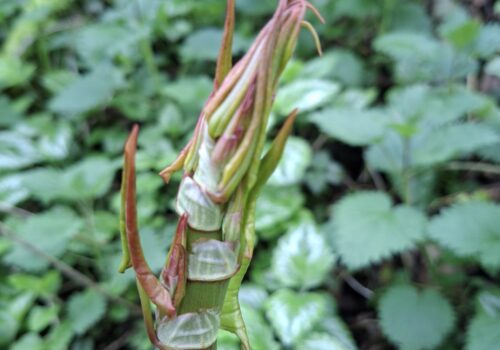
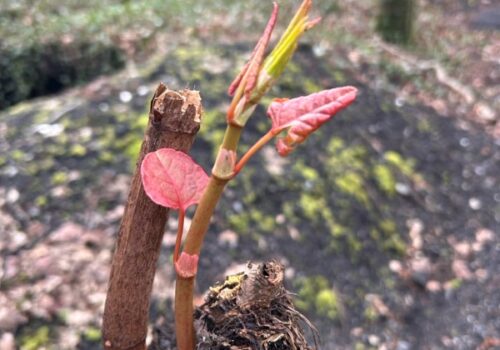
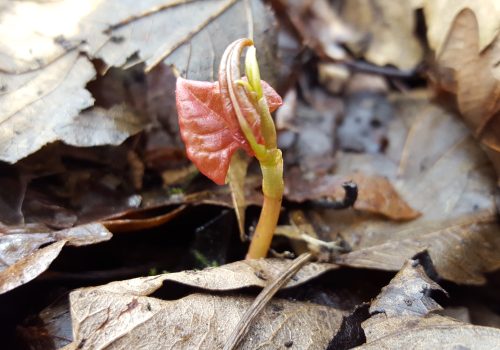
Early and correct identification of Japanese knotweed growth is the first important step in managing your knotweed problem and implementing a removal strategy.  Whether you’re a RICS Surveyor, a Construction Site Manager or Property Owner, if you suspect the presence of knotweed send us a picture of suspect plant to ident@knotweed.co.uk or quote@knotweed.co.uk. We can identify it for you and provide a free no obligation eradication quotation for your perusal, or organise a Japanese knotweed survey if necessary.

Post By Ben Lindley of Japanese Knotweed Ltd

Posted by Ben Lindley JKLtd | April 9th, 2012

RICS knotweed advice paper released

Japanese Knotweed Ltd is please to have been able to assist RICS (Royal Institute of Chartered Surveyors) in developing the UK’s first cross-industry approved advice for surveyors and banks to ensure the risk of Japanese Knotweed in and around residential property is accurately assessed and quantified.

Surveyors and lenders can refer to the information paper to categorise the property risk that Japanese knotweed presents and involve a specialist knotweed contractor if required.  Category one is the lowest risk, when the plant is 7m or more from habitable space and on adjacent land only.  Category four is the highest risk, when the plant is within 7m of habitable space on the title property.

This move will help to ensure consistent assessment and reporting of the plant to banks and enable lenders to establish a clear lending policy for loan applicants.

It certainly has been a stressful time for vendors, who in the last 12 months have found potential sales thwarted by the presence of knotweed.  Japanese Knotweed Ltd hope that this will now provide property owners with sensible and achievable solutions that enable their property sale to proceed.

Home owners and occupiers with Japanese Knotweed can eradicate the plant by hiring Japanese Knotweed contractor who treat the plant with specialist chemicals. With roots as deep as 3m, it can take treatment over several seasons to kill it effectively.

Japanese Knotweed contractors will provide their clients with certification to demonstrate that the Japanese Knotweed has been effectively treated and no longer exists on or close to the property to reassure future buyers and lenders.

To read the RICS press release follow this link: http://www.rics.org/site/scripts/press_article.aspx?categoryID=509&pressReleaseID=772

Posted by Ben Lindley JKLtd | March 29th, 2012

Japanese Knotweed Removal and the Quick Fix

The only quick fix in eradicating Japanese knotweed is excavation with disposal on site as a burial or removal off site to a specialist Landfill Site licensed to receive Japanese knotweed. Treating knotweed under a systemic herbicide programme with the aim of achieving eradication takes patience and persistence. It does not matter what anyone says, in nearly every case there is NO quick fix with herbicide alone.

Systemic herbicides are used to try and exhaust the rhizome system of its ability to produce growth, but this can take 3-5 years on average to achieve. Residual herbicides can be used from the outset of treatment, but this more often than not simply results in forced dormancy and false eradication results (i.e. the residual herbicide forms a chemical barrier in the soil, which wears off 1-2 years later and the knotweed returns).

The herbicide will often be applied in a variety of techniques (i.e. Knapsack Spraying, Stem Injection, Weed Wiping etc…), but no one way is significantly more effective than the other.  Its quite normal for a combination of techniques to be used during a treatment programme for logistical purposes.  Stem Injection alone for example in nearly all cases, as with other the other techniques, will not result in single season eradication unless the plant is particularly juvenile.

Importantly please be advised, developers especially,  that NO ONE can guarantee that the herbicide has ultimately removed the viability from 100% of the underground rhizome system.  This is why the Environment Agency class ground which contains dead knotweed (even once a knotweed specialist has deemed it eradicated via herbicide or even sifting for that matter) as controlled waste if it leaves site.  This is the same waste classification as when the knotweed was green and healthy!  For developers therefore the on way of truly being assured of knotweed eradication (in the true meaning of the word) and clean site soils is excavation, with on site burial or off site disposal of the arising.

There is a lot of media hype currently in regard to Japanese knotweed, some of which can be ignored, but be under no illusion, this is a strong, persistent and troublesome plant to eradicate.  It is therefore imperative that you choose your knotweed specialist wisely:

We are a dedicated knotweed specialist. Our staff and partners live and breathe all things knotweed, so who better to choose to solve your knotweed problem?  Drop us an email quote@knotweed.co.uk or pick up the phone 01795 511 057 today.

By Ben Lindley of Japanese Knotweed Ltd

Posted by Ben Lindley JKLtd | March 1st, 2012

25 Year Insurance Backed Warranties

Japanese Knotweed Ltd provides our customers absolute piece of mind with Insurance Backed Warranties for periods up to 25 years!

Our insurance backed warranties are fully bonded; so that the warranty agreement is controlled by a third party on behalf of the customer ensuring service delivery and importantly complete financial security.

What does this mean? Well, if for what ever reason we failed to deliver the warranty service or even became insolvent, the contract money is held secure by the third party. If required this then enables another knotweed specialist contractor to complete the warranty agreement or the remaining contract money would be returned to the customer forthwith.

As a professional and reputable knotweed specialist Japanese Knotweed Ltd are able to provide these types of warranties, which are compatible with all major lenders requirements when buying a house / property, after we have eradicated the knotweed.

If you’ve found knotweed and/or knotweed is causing you a problem we can solve it and provide an insurance backed warranty.

Call us today on 01794 511 057 or email quotes@knotweed.co.uk

Posted by Ben Lindley JKLtd | December 6th, 2011

Conveyance Surveys and Knotweed

Japanese Knotweed Ltd were pleased to provide a presentation on Japanese knotweed to the Royal Institute of Chartered Surveyors (RICS) in London last month.

The request for this educational presentation was made to provide an understanding as to why lending is being refused on properties with Japanese knotweed. RICS surveyors are now under increasing pressure to correctly identify the presence of knotweed for the lender and buyer (if commissioned) whilst surveying a property.

Our presentation provided explanation of knotweed, in-depth identification, actions and solutions if found. This was well received by RICS surveyors present, who felt it bolstered their knowledge and confidence.

These presentations as well as actions being undertaking by others to educate insurers, lenders and surveyors about Japanese knotweed will ultimately provide a sensible appraisal of the property risk that Japanese knotweed presents.

A recent invasive weed conference hosted by RPS Planning and Development Ecologist Consultants at London Zoo and attended by Swam also announced actions by head of RICS to address conveyance issues relating to knotweed.

If you have a knotweed problem on a property you are trying to buy, sell or re-mortgage call us on 01794 511057 or email us at quotes@knotweed.co.uk for a prompt and professional response.

Posted by Ben Lindley JKLtd | October 19th, 2011

Japanese knotweed and Mortgages

Japanese knotweed is considered by some lenders to be an unacceptable problem and therefore can prevent the sale of a property. In some cases the same can apply if there is knotweed on an adjacent property.

If you are considering the sale of your property, immediate excavation and removal of any knotweed on or adjacent to your property (possibly backed with a twenty year warranty) may be the only option you have to ensure a successful property sale.

Working throughout the UK, our expertise and experience with Japanese knotweed enables us to deliver problem solving solutions in a timely and cost effective manner. Call today 01794 511 057 or email quotes@knotweed.co.uk.

Posted by Ben Lindley JKLtd | September 16th, 2011

Blooming Weeds and Seeds

On our travels across the country this week the bright yellow flowers of Common Ragwort have been very noticeable. The non-native invasive weeds; Giant Hogweed and Himalayan Balsam, have and will also now start going into flower.

All three of these weeds are undesirable (in most situations) and you have a legal obligation to eradicate Ragwort from your land! Ragwort is poisonous to handle (and toxic to horses when ingested) and the sap of the Giant Hogweed can severely burn human skin.

After flowering each of these plants will produce seeds but disperse them in different ways. Common Ragwort produce the recognisable late summer air born downy seeds. Giant Hogweed produces seeds on mass (up to 50,000 seeds per plant), which are distributed up to 4m away. Himalayan Balsam is also known as ‘Jumping Jack’, for its seed pods split and coil within a fraction of a second of being touched, literally exploding the seeds out away from the plant for up to 7m.

Effective control of the these types of weeds is achieved by killing the plants before they produce viable seeds. Ideally this means manual removal or chemical application before the plants flower, but they can still be treated now in the early stages of flowering before viable seeds are generated. In most situations control is achieved over successive seasons of treatment.

Japanese knotweed (Fallopia japonica) does not spread by seed, as we only have the female form of the plant in the UK and therefore no viable seeds are produced following flowering. This invasive weeds spreads mainly via vegetative re-generation. However this plant is now causing specific problems with sellers and buyers of property because many lenders are now reluctant to provide mortgages on properties with knotweed.

If you have Common Ragwort, Giant Hogweed, Himalayan Balsam or Japanese knotweed please call (01794 521 582) or email (quotes@knotweed.co.uk) and we can provide a control and removal solution.

Posted by Ben Lindley JKLtd | June 11th, 2011

Spring has sprung

I’m sure that like everyone here, you are also welcoming the early warm weather this year after the cold winter we’ve had.

The warm days have led to a fairly early appearance for the Japanese knotweed, which is sending up this seasons new shoots at the moment and unfurling its first leaves.  If you currently have an herbicide eradication programme with us we will be attending in the next few weeks to re-commence works, but if your finding for the first time that you have knotweed and need it removed please call on 01794 521 582 or 017942 511 057 or email: quote@knotweed.co.uk and we can help.

The pretty looking but highly invasive Himalayan Balsam will be in its early growth stage at the moment as well.  If you have this invasive non-native weed on your property now is the best time to treat it.  Call or email us and we can provide advice and swing into action.

To help you identify the early season growth stages of knotweed please go the following section of our website:  http://www.japaneseknotweed.co.uk/Japanese-Knotweed-Growth

Posted by Ben Lindley JKLtd | April 6th, 2011